2026

Escaping from the Shadow: Bottleneck-Aware UAV Placement for High-Throughput Relaying

Dongrak Choi, Yongjae Yoo, Yubin Choi, Jeongyeup Paek, Saewoong Bahk

IEEE 103rd Vehicular Technology Conference (VTC) 2026

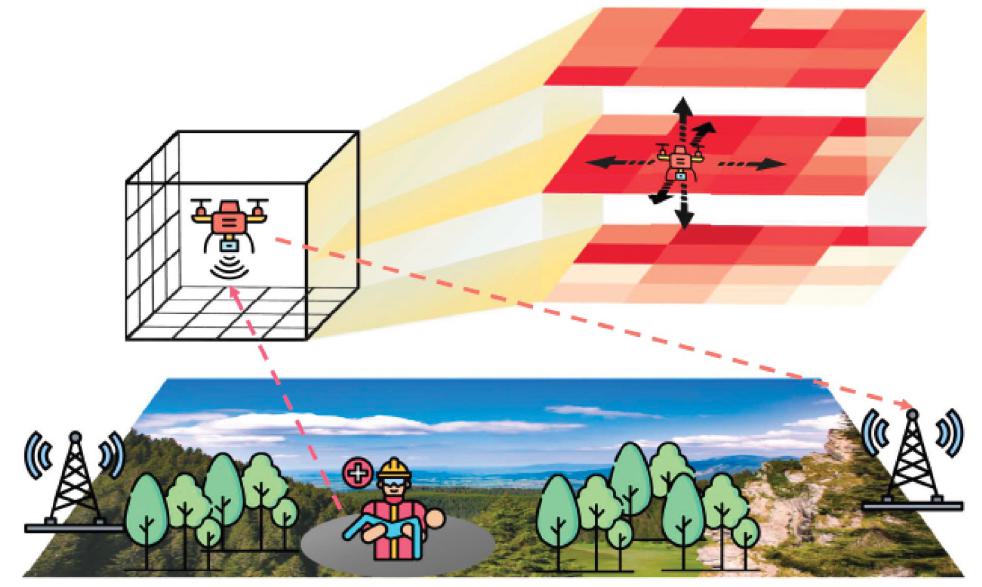
Cellular communication inevitably has shadow zones due to geographical and economical reasons. In shadow areas, using unmanned aerial vehicle (UAV) relay between the user and the base station can be a viable and immediate solution to enable high throughput communication instantly. However, the location and altitude of the UAV have a significant impact on end-to-end throughput, making relay placement critical. In this paper, we propose UPS, a UAV relay placement system that identifies the bottleneck between UE–UAV and UAV–BS links and continuously relocate the UAV to a position that meets the throughput criteria for high-quality live streaming. We measure real UE–UAV–BS links by flying a UAV in actual shadow zones, and evaluate in a trace-driven manner. Results show that UPS not only satisfies the highest requirement for up to 40% longer periods than compared schemes, but also achieves them faster.

Escaping from the Shadow: Bottleneck-Aware UAV Placement for High-Throughput Relaying

Dongrak Choi, Yongjae Yoo, Yubin Choi, Jeongyeup Paek, Saewoong Bahk

IEEE 103rd Vehicular Technology Conference (VTC) 2026

Cellular communication inevitably has shadow zones due to geographical and economical reasons. In shadow areas, using unmanned aerial vehicle (UAV) relay between the user and the base station can be a viable and immediate solution to enable high throughput communication instantly. However, the location and altitude of the UAV have a significant impact on end-to-end throughput, making relay placement critical. In this paper, we propose UPS, a UAV relay placement system that identifies the bottleneck between UE–UAV and UAV–BS links and continuously relocate the UAV to a position that meets the throughput criteria for high-quality live streaming. We measure real UE–UAV–BS links by flying a UAV in actual shadow zones, and evaluate in a trace-driven manner. Results show that UPS not only satisfies the highest requirement for up to 40% longer periods than compared schemes, but also achieves them faster.

2025

Intelligent Channel State Information Feedback Using Variable-Rate Autoencoder

Yubin Choi, Yunseo Nam, Saewoong Bahk

International Conference on Information and Communication Technology Convergence (ICTC) 2025

Accurate channel state information (CSI) at the base station (BS) is crucial for achieving high beamforming gains in massive multiple-input multiple-output (MIMO) systems. In frequency division duplex (FDD) systems, the BS relies on feedback from the users (UEs) to obtain CSI. However, the aggressive CSI compression and quantization at the UE limits the achievement of the optimal beamforming gains. To resolve this problem, we propose an autoencoder network that learns a compact, discrete representation of the channel for variable feedback rates. We train and evaluate our variable-rate autoencoder using a large synthetic dataset, generated through advanced 3D modeling tools and ray-tracing simulators. Simulation results demonstrate that the proposed network achieves more accurate channel reconstruction compared to competitive methods.

Intelligent Channel State Information Feedback Using Variable-Rate Autoencoder

Yubin Choi, Yunseo Nam, Saewoong Bahk

International Conference on Information and Communication Technology Convergence (ICTC) 2025

Accurate channel state information (CSI) at the base station (BS) is crucial for achieving high beamforming gains in massive multiple-input multiple-output (MIMO) systems. In frequency division duplex (FDD) systems, the BS relies on feedback from the users (UEs) to obtain CSI. However, the aggressive CSI compression and quantization at the UE limits the achievement of the optimal beamforming gains. To resolve this problem, we propose an autoencoder network that learns a compact, discrete representation of the channel for variable feedback rates. We train and evaluate our variable-rate autoencoder using a large synthetic dataset, generated through advanced 3D modeling tools and ray-tracing simulators. Simulation results demonstrate that the proposed network achieves more accurate channel reconstruction compared to competitive methods.

Demo: A Programmable High-Throughput Duplex DC-PLC Testbed for Power and Data Integration

Dongrak Choi, Yonghoon Jeong, Yubin Choi, Saewoong Bahk

IEEE International Conference on Network Protocols (ICNP) 2025
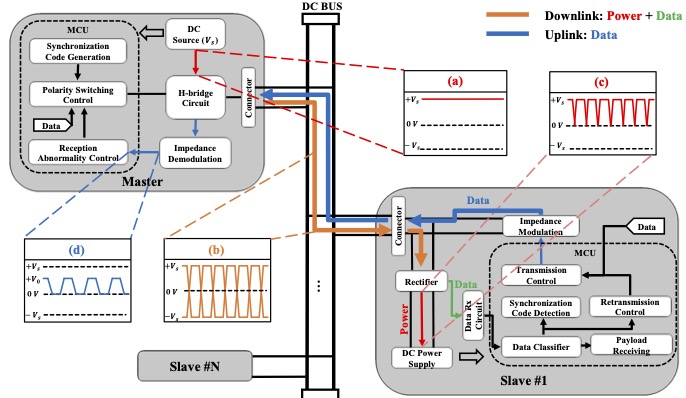
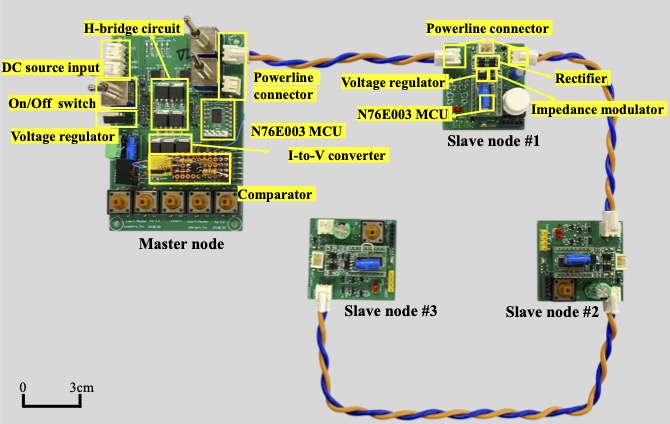
Interest in Direct Current Power Line Communication (DC-PLC) is growing as industries seek to reduce wiring complexity and cost by combining power and data over a single medium. A programmable DC-PLC testbed is developed to enable power transfer and bidirectional communication over a shared DC power line bus. The system employs a master–slave scheme in half-duplex mode under a flexible MAC protocol, using Voltage Polarity Modulation (VPM) for downlink and Current Amplitude Modulation (CAM) for uplink. Implemented with low-cost microcontrollers, the master and slave are designed as modular units for easy connection and expansion. The platform achieves approximately 100 kbps throughput in both directions and demonstrates reliable operation with a simple polling-based MAC protocol, highlighting its potential for future DC-PLC research and applications.

Demo: A Programmable High-Throughput Duplex DC-PLC Testbed for Power and Data Integration

Dongrak Choi, Yonghoon Jeong, Yubin Choi, Saewoong Bahk

IEEE International Conference on Network Protocols (ICNP) 2025

Interest in Direct Current Power Line Communication (DC-PLC) is growing as industries seek to reduce wiring complexity and cost by combining power and data over a single medium. A programmable DC-PLC testbed is developed to enable power transfer and bidirectional communication over a shared DC power line bus. The system employs a master–slave scheme in half-duplex mode under a flexible MAC protocol, using Voltage Polarity Modulation (VPM) for downlink and Current Amplitude Modulation (CAM) for uplink. Implemented with low-cost microcontrollers, the master and slave are designed as modular units for easy connection and expansion. The platform achieves approximately 100 kbps throughput in both directions and demonstrates reliable operation with a simple polling-based MAC protocol, highlighting its potential for future DC-PLC research and applications.

D<sup>2</sup>-PLC: Holistic Design and Implementation of High-Datarate Duplex DC Power Line Communication Network
D2-PLC: Holistic Design and Implementation of High-Datarate Duplex DC Power Line Communication Network

Dongrak Choi, Yubin Choi, Yonghoon Jeong, Jeongyeup Paek, Saewoong Bahk

IEEE Internet of Things Journal (IoTJ) 2025

Recent advances in electric vehicles, robots, and renewable energy have renewed interest in direct current (DC) power line communication (PLC) technology. However, exist- ing DC-PLC systems face several limitations, including low datarates, lack of support for duplex communication, and the absence of an effective medium access control (MAC) mechanism. To overcome these challenges, we propose D2-PLC, a novel DC- PLC system that features a redesigned physical layer, enabling high-speed duplex communication over a single pair of wires supporting simultaneous power and data transmission. D2-PLC introduces voltage polarity modulation (VPM) and current ampli- tude modulation (CAM) for downlink and uplink communication, respectively. In addition, we develop a custom data link layer and MAC protocols to coordinate communication in a bus topology where multiple slave nodes interact with a single master node (the power source), minimizing the risk of collisions. We implement a fully functional prototype and evaluate on a 5-node testbed as well as via 256-node simulations. Results demonstrate that D2-PLC achieves a maximum datarate of ∼100 kbps, 260% improvement over existing solutions, while maintaining 99+% reliability. These findings highlight D2-PLC’s potential to reduce the cost and weight of battery-powered systems such as electric vehicles.

D2-PLC: Holistic Design and Implementation of High-Datarate Duplex DC Power Line Communication Network

Dongrak Choi, Yubin Choi, Yonghoon Jeong, Jeongyeup Paek, Saewoong Bahk

IEEE Internet of Things Journal (IoTJ) 2025

Recent advances in electric vehicles, robots, and renewable energy have renewed interest in direct current (DC) power line communication (PLC) technology. However, exist- ing DC-PLC systems face several limitations, including low datarates, lack of support for duplex communication, and the absence of an effective medium access control (MAC) mechanism. To overcome these challenges, we propose D2-PLC, a novel DC- PLC system that features a redesigned physical layer, enabling high-speed duplex communication over a single pair of wires supporting simultaneous power and data transmission. D2-PLC introduces voltage polarity modulation (VPM) and current ampli- tude modulation (CAM) for downlink and uplink communication, respectively. In addition, we develop a custom data link layer and MAC protocols to coordinate communication in a bus topology where multiple slave nodes interact with a single master node (the power source), minimizing the risk of collisions. We implement a fully functional prototype and evaluate on a 5-node testbed as well as via 256-node simulations. Results demonstrate that D2-PLC achieves a maximum datarate of ∼100 kbps, 260% improvement over existing solutions, while maintaining 99+% reliability. These findings highlight D2-PLC’s potential to reduce the cost and weight of battery-powered systems such as electric vehicles.